News Categories
Latest News

NASA’s Curiosity Rover is Investigating Unusual Polygon Structures That Look Like a “Giant Martian Honeycomb” - The Debrief
An odd-looking series of polygon-shaped structures have been discovered on Mars, as revealed in new images obtained by NASA’s Curiosity Rover.

Over six days in July of 1994, 21 fragments of a comet named Shoemaker-Levy 9 crashed one after another into the atmosphere of Jupiter as telescopes across the world watched — the first time in recorded history that human beings had ever directly observe - Space Daily
The first time human beings ever watched two objects hit each other in space was in July 1994, and the observation happened almost by accident because a husband-and-wife astrogeologist team and their Canadian friend had gone to look at Jupiter with a telescop…

Ultrafast scanning tunneling microscopy reaches the quantum mechanical space-time limit for the first time - Phys.org
Werner Heisenberg’s famous uncertainty principle describes one of the most intriguing features of quantum physics: certain pairs of physical quantities describing a particle, such as position and momentum, cannot simultaneously be determined with arbitrary pr…

Researchers found that on days people did more small kind things for others, the usual toll of stress on their mood and mental health tended to be noticeably softened - Space Daily
Do a few small kind things on a bad day, and the day may sting less. That is the plain finding of a 2016 study in Clinical Psychological Science. Researchers followed 77 adults for two weeks and found something simple: on days when people did more small helpi…

JWST discovers a new barred spiral galaxy - Phys.org
An international team of astronomers reports the discovery of a new massive barred spiral galaxy. The newfound galaxy, designated M1149-BSG-z5, was identified using the James Webb Space Telescope (JWST). The finding was detailed in a paper published June 23 o…
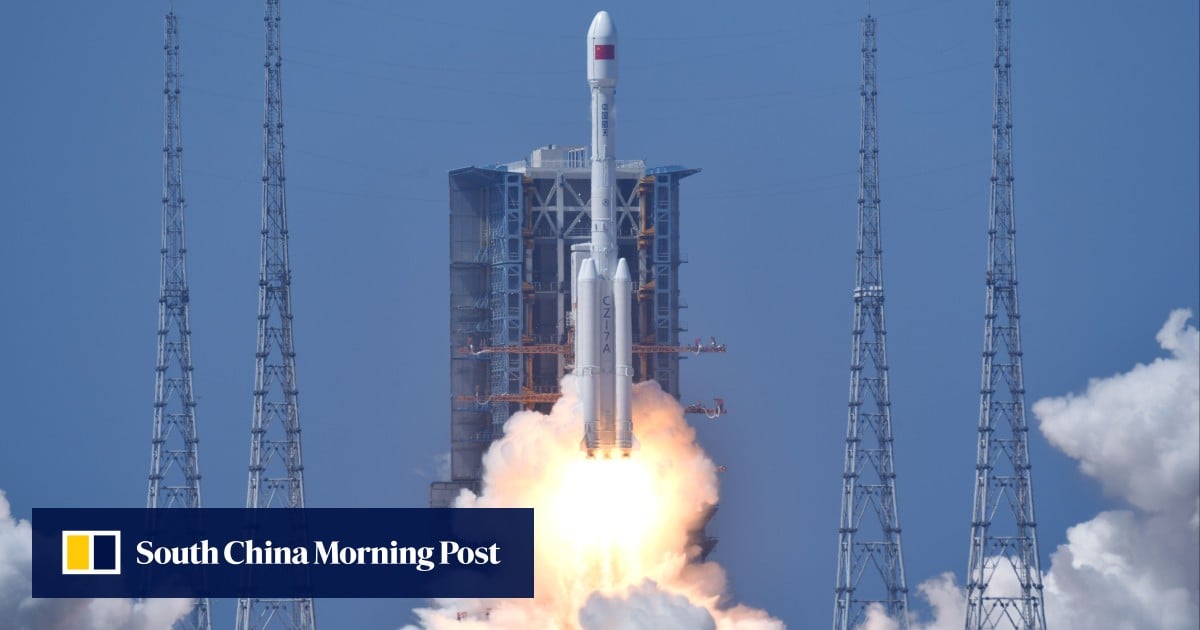
China’s satellite engine smashes record, leaves US rival far behind - South China Morning Post
Forced to develop the technology from scratch, a Chinese team says it achieved 14 hours of continuous operation in space.